A roof box can make the difference between a cramped car and a comfortable holiday, but only if it is loaded properly. This roof box weight limit guide is here to clear up one of the most common points of confusion: how much weight you can actually carry on the roof without risking damage, poor handling or an unsafe journey.
The tricky part is that there is no single number that suits every car. The safe limit depends on the vehicle, the roof bars and the roof box itself. If one part of that setup has a lower maximum load than the others, that lower figure is the one that matters.
Roof box weight limit guide – what the limit really means
When people talk about roof box weight limits, they often mean one of two things. The first is the weight the roof box manufacturer says the box can hold. The second is the maximum roof load your car is designed to carry. Those are not always the same, and it is the lower number that decides what is safe.
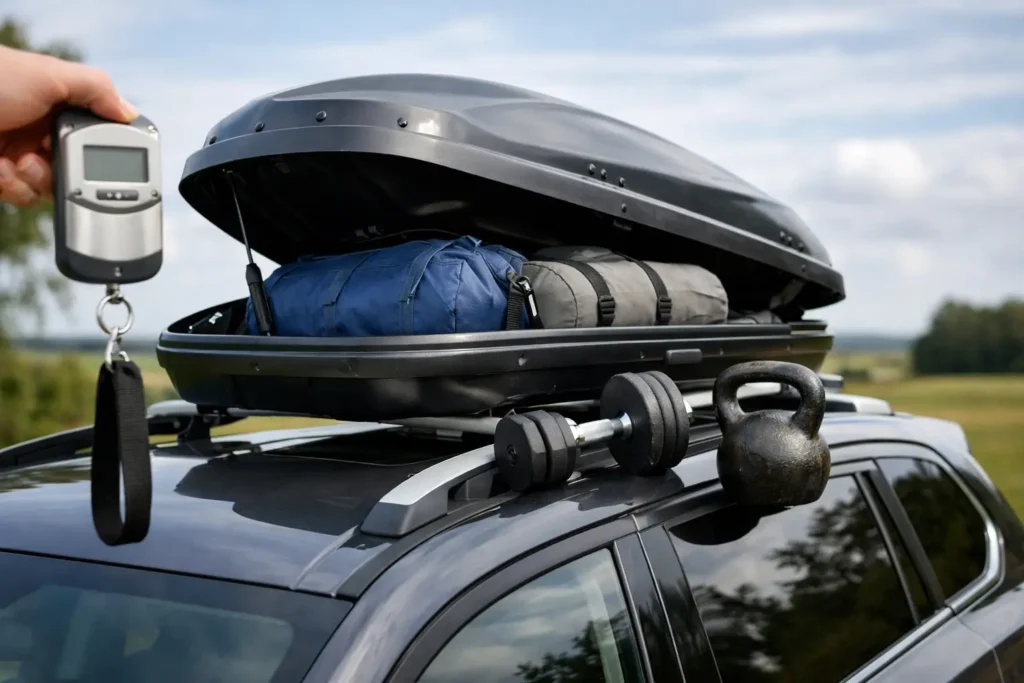
For example, a roof box may be rated to carry 75kg, but your vehicle might only allow a total roof load of 60kg. In that case, 60kg is your real limit. You also need to remember that the vehicle roof load usually includes the weight of the roof bars and the roof box itself, not just your luggage.
That is the bit many drivers miss. If your bars and box together already weigh a fair amount, the remaining allowance for bags, pushchairs or camping gear can be much less than expected.
Start with your vehicle’s maximum roof load
The first place to check is your car handbook or manufacturer information. Look for the maximum roof load, sometimes called the permissible roof load. This figure is set by the vehicle maker and takes account of the roof structure, mounting points and overall stability.
On many family cars, the roof load is often around 50kg to 75kg, though it can vary a lot. Smaller cars may allow less. Larger estates, SUVs and some 4x4s may allow more, but never assume. A bigger car does not always mean a bigger roof load limit.
If your vehicle has a 75kg roof load limit, that does not mean you can put 75kg of luggage in the box. You must subtract the weight of the roof bars and the empty roof box first. If the bars weigh 5kg and the box weighs 15kg, you have 55kg left for your actual load.
That is why professional fitting helps. It takes the guesswork out of matching the right equipment to the right vehicle and makes sure the full setup is suitable from the start.
The roof bars and box matter too
A proper roof box weight limit guide also needs to cover the supporting equipment. Roof bars have their own load rating, and so does the roof box. Even if the car can carry a certain amount, the bars or the box may allow less.
Think of the whole setup as a chain. The safe limit is only as strong as the weakest link. If your car allows 75kg, your bars are rated for 75kg and your box is rated for 50kg, then 50kg is your maximum for the box itself. If your car only allows 60kg total including the equipment, then the vehicle limit still takes priority.
Quality branded equipment helps because the ratings are clear and the fit is designed to work properly with specific vehicles. That makes a real difference when you are travelling with family and want a straightforward, dependable setup rather than a lot of uncertainty.
Volume is not the same as weight
This catches people out all the time. A large roof box may offer 470 litres of space, but that does not mean you can fill every inch with heavy items. Capacity in litres tells you how much room there is. Weight limit tells you how much load the system can safely carry.
In practice, roof boxes are best used for lighter but bulky items. Clothing, bedding, coats, soft bags and camping kit are usually better candidates than very dense loads. If you fill a roof box with books, tools or heavy electrical items, you can hit the weight limit long before the box looks full.
So if the box still has room, that does not automatically mean it has spare carrying capacity.
How to pack within the limit
The safest way to load a roof box is to put lighter, bulky items in the roof box and keep heavier luggage lower down in the car boot. That helps in two ways. It keeps you within the roof load limit and it keeps the car’s centre of gravity lower, which improves stability on the road.
Spread the weight evenly across the box rather than piling it all at one end. Avoid loose items shifting about, and always secure the contents properly using the internal straps or fixing points provided. Uneven loading can affect handling and can put extra strain on one part of the box or bar system.
It is also worth being realistic about what needs to go up top. If you are travelling with prams, travel cots, sleeping bags or extra coats, a roof box is ideal. If you are deciding whether to put heavy suitcases in the box, it is usually better to keep the heaviest case in the boot if space allows.
Why overloading is a real problem
An overloaded roof box is not just a technical issue. It can change how your car behaves. Steering may feel less precise, braking distances can increase and strong crosswinds can affect the car more than usual. You may also notice more body roll on bends or roundabouts.
There is also the risk of damaging the roof bars, stressing the mounting points or putting too much force through the roof structure. In the worst cases, an insecure or overloaded setup can become dangerous during emergency braking or motorway driving.
This is one of those areas where close enough is not good enough. A few extra kilos may not sound like much when you are packing on the drive, but they matter once you are at speed with a full car and a long journey ahead.
It depends on what you are driving and where you are going
Not every journey puts the same demands on a roof box. A short local trip at moderate speeds is different from a fully loaded motorway run to Cornwall or a ferry crossing followed by mountain roads abroad. The longer and faster the journey, the more important correct loading becomes.
Weather matters too. Wind, heavy rain and poor road surfaces all place more strain on the vehicle and roof load. If you know you will be covering long distances with children, pets and a packed boot, staying comfortably within the limit is the sensible approach.
That is another reason many motorists choose hiring over buying. You get equipment suited to the trip without having to figure out every detail alone, and you avoid paying for something bulky that will spend most of the year in the garage.
Roof box weight limit guide – common mistakes to avoid
The most common mistake is counting only the luggage and forgetting the weight of the bars and box. The next is assuming all cars can take the same load. Another is using the roof box for the heaviest items simply because the box looks spacious.
People also sometimes load the box unevenly, fail to secure the contents inside or forget that a loaded roof box changes the car’s height and handling. None of these mistakes are hard to avoid, but they do matter.
If you are unsure, ask before travelling rather than guessing on the morning of departure. A professional fitting service can check compatibility, confirm safe limits and make sure everything is mounted properly. For many families, that reassurance is worth just as much as the extra luggage space.
For drivers across Staffordshire and the West Midlands, that is exactly why South Staffordshire Roof Box Hire keeps things simple with properly fitted, branded equipment and clear advice on safe use.
Before you set off, give yourself five extra minutes on the drive. Check the stated limits, think about what you have packed and make sure the load is sensible as well as legal. A roof box should make your trip easier, not give you something else to worry about.
