You only need to turn up with the wrong roof bars once to realise the answer to do roof bars fit all cars is a simple no. A set that fits one hatchback might be completely wrong for another, even if the cars look almost identical from the outside. That is why roof bars are never really a one-size-fits-all accessory, and why getting the match right matters for safety as much as convenience.
For anyone planning a family holiday, a camping trip or just trying to free up boot space, this is usually the point where the questions start. Will your car take roof bars at all? Does the make and model matter? What if the car has rails already? And can you swap bars between vehicles? The honest answer is that it depends on the car, the roof type and the fitting kit.
Do roof bars fit all cars? The short answer
Roof bars do not fit all cars because cars do not all have the same roof design. Some vehicles have raised roof rails running front to back. Others have flush rails that sit close to the roofline. Some have fixed mounting points hidden under small covers, and some rely on a clamp system that grips the door frame area. There are also cars with roof shapes or glass roof sections that limit what can be fitted.
Even when two cars come from the same manufacturer, the correct bars and fittings can still be different. A Ford Focus estate may need a different setup from a Focus hatchback. A newer version of the same model can also change roof dimensions enough to make older bars unsuitable. That is why compatibility is usually based on the exact make, model, body style and year.
Why roof bar compatibility varies so much
The biggest factor is the way the roof is built. Roof bars need secure attachment points, and manufacturers design these differently across their range. The bars themselves are only one part of the system. In many cases, you also need the right feet and the correct fitting kit for that specific vehicle.
Think of it as three parts working together: the bar, the foot pack and the fitting kit. If one part is wrong, the whole setup can be unsafe or simply impossible to install. That is often what catches people out when they buy second-hand bars online or borrow a set from family.
There is also the issue of roof load limits. Even if bars can physically be fitted, the car still has a maximum roof load set by the vehicle manufacturer. That figure includes the weight of the bars and any roof box or luggage. Smaller cars and some electric vehicles can have tighter limits than people expect.
The main roof types and what they mean
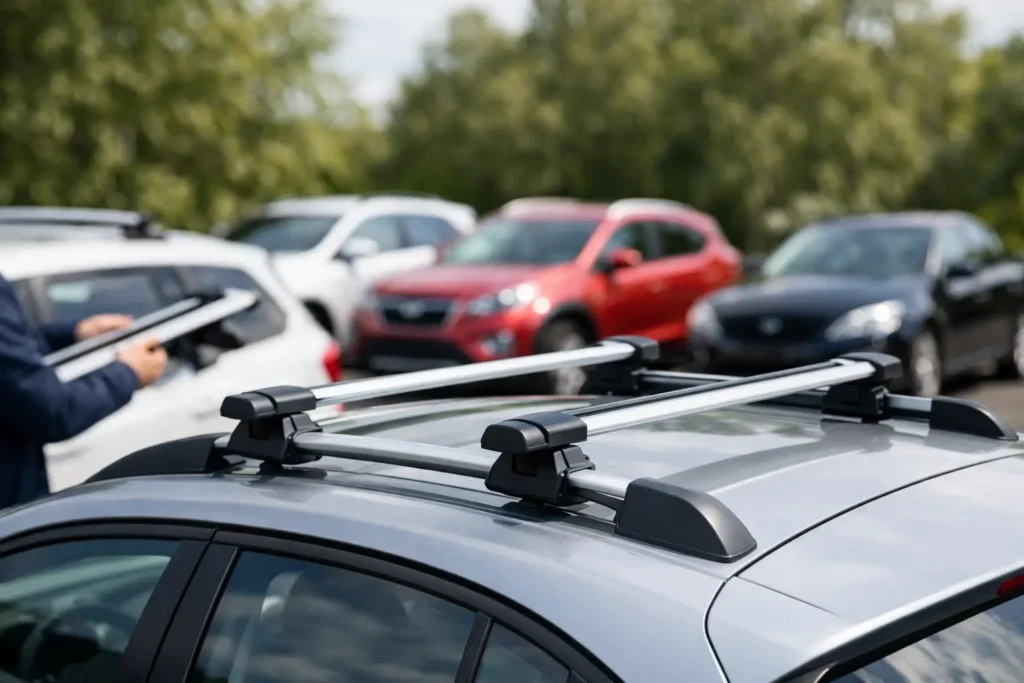
Raised roof rails are usually the most straightforward. These are the rails with a clear gap underneath, and the bars typically attach around them. They are common on estates, SUVs and some crossovers.
Flush roof rails look similar at first glance, but they sit directly against the roof with no gap. They need a different fitting method, so bars designed for raised rails will not work.
Fixed points are another common setup. These are manufacturer-designed mounting points, often hidden behind little covers or trim sections. They are secure, but only when matched with the correct kit.
Then there are normal roofs with no rails at all. On these cars, bars often use a clamp fitting around the door frame area. This can work very well, but it must be the right kit for the vehicle. The shape of the roofline, the door aperture and even trim details all matter.
Some cars are more awkward. Panoramic glass roofs, soft tops and certain sporty models can restrict or rule out roof bar use altogether. If a vehicle handbook says no roof load is permitted, that is the end of the conversation.
Can you reuse roof bars from an old car?
Sometimes, but not as often as people hope.
If the bars are from a modular system, you may be able to reuse the bar itself while changing the feet or fitting kit to suit the new car. That can be a sensible option. But if the full setup was built around one specific roof type, it may not transfer at all.
This is where people can get into trouble by assuming close enough is good enough. It is not. If the bars sit slightly wrong, if the clamps are not shaped correctly, or if the kit is for a different model year, you can end up with movement, poor weight distribution or damage to the car.
For occasional use, hiring tends to avoid that guesswork. You get bars that match your vehicle rather than trying to make an old set do a job it was not designed for.
How to tell if your car can take roof bars
The first place to check is the vehicle handbook. That should tell you whether the car is approved for roof bars and what the maximum roof load is. It may also describe the roof type or show where the mounting points are.
After that, the key details are the registration, make, model, year and body style. Estate, saloon and hatchback versions of the same car can all differ. If your car has rails, you also need to know whether they are raised or flush.
Photos can help, but they do not always tell the full story. What looks like a standard rail setup can turn out to be something more specific once you inspect it closely. That is one reason many drivers prefer a fitting service rather than trying to interpret product charts themselves.
Why the right fit matters for safety
Roof bars are not just there to hold extra luggage. They are carrying weight at speed, in wind, in rain and during braking or cornering. If the fit is wrong, the risk is not just noise or inconvenience. It can affect stability, damage the roof and, in the worst case, lead to equipment coming loose.
A correctly fitted set of bars should sit evenly, clamp securely and be tightened to the proper specification. The load should also be distributed properly and kept within the vehicle limit. That matters even more when adding a large roof box, because the combined height and weight change how the car behaves on the road.
For most drivers, this is not something they want to trial-and-error the night before travelling.
The easiest route if you only need them for a trip
If you are only using roof bars for one holiday or the odd weekend away, buying a full setup can feel like a lot of expense for very little use. Then there is storage afterwards, plus the worry of whether you have ordered the correct kit in the first place.
That is why roof bar hire appeals to so many families and occasional travellers. You avoid paying full retail prices for equipment that may spend most of the year in the garage, and you do not have to sort through compatibility tables on your own. A professional fitting service also removes the uncertainty around safety and saves time on the day.
For local motorists, that is where a business like South Staffordshire Roof Box Hire makes life easier. Instead of guessing whether one universal-looking set will do, you can have the correct bars prepared for your specific car and fitted properly before you set off.
Common mistakes people make
The most common mistake is assuming universal means universal. In practice, many products described that way still rely on vehicle-specific parts. Another is overlooking the roof load limit and counting only the luggage, not the weight of the bars and box.
People also underestimate model-year changes. A facelifted version of the same car can need a different fit kit. Borrowing bars from a friend can work if the vehicles are genuinely compatible, but it is never worth assuming.
Then there is simple fitting confidence. Plenty of drivers are capable of doing it themselves, but plenty would rather not be tightening roof gear while checking YouTube videos on the drive. There is nothing wrong with choosing the easier option when the journey matters.
What to do before you book or buy
Start with the exact vehicle details and check whether the car is approved for roof loading. Identify the roof type properly, not just by appearance. If you are adding a roof box, think about total weight, not just space.
If you plan to use bars regularly across several years, ownership may make sense. If this is for one or two trips a year, hiring is often the better-value choice. You get the right setup without the long-term cost, storage hassle or risk of ending up with bars that do not fit your next car.
A bit of checking now saves a lot of stress later. The right roof bars should feel like a simple solution, not another travel problem to sort out the night before you leave.
