You usually realise you need extra boot space at the worst possible moment – when the suitcases are lined up, the kids’ bags keep appearing from nowhere, and the dog still needs room in the back. If you are wondering how to choose roof box options that actually suit your car and your trip, the right answer is not always the biggest one you can find. A good roof box should fit your vehicle properly, carry what you need safely, and make travelling easier rather than more awkward.
For most people, the decision comes down to four things: size, compatibility, ease of use and value for money. Get those right and a roof box feels like a simple upgrade for a family holiday, camping trip or airport run. Get them wrong and you can end up with clearance issues, wasted space, difficult fitting or a box that is far more expensive than you really needed.
How to choose roof box size
The first question is not “what is the biggest roof box available?” It is “what do I actually need to carry?” That sounds obvious, but it is where many people go wrong.
If you are packing for a week away with two adults and a couple of children, a large roof box is often ideal for the bulky but lighter items that fill a boot quickly – soft bags, pushchair parts, coats, bedding or camping gear. A roof box gives you breathing room inside the car, which matters even more on a long journey when passengers need proper space.
Bigger is not always better, though. A very long or tall box can look appealing because it promises loads of storage, but the trade-off is weight, wind resistance and fit. On some vehicles, an oversized box can interfere with the tailgate opening or simply look and feel out of proportion. If you only need occasional extra capacity for family luggage, a roomy but sensible option is usually the best choice.
A 470-litre roof box is a strong all-round size for many UK motorists because it offers serious extra space without being excessive for everyday family cars. It is large enough to make a real difference on holiday, but still practical for a wide range of vehicles.
Check the roof box fits your car properly
This is the part that matters most. Even an excellent roof box is the wrong choice if it does not work with your vehicle.
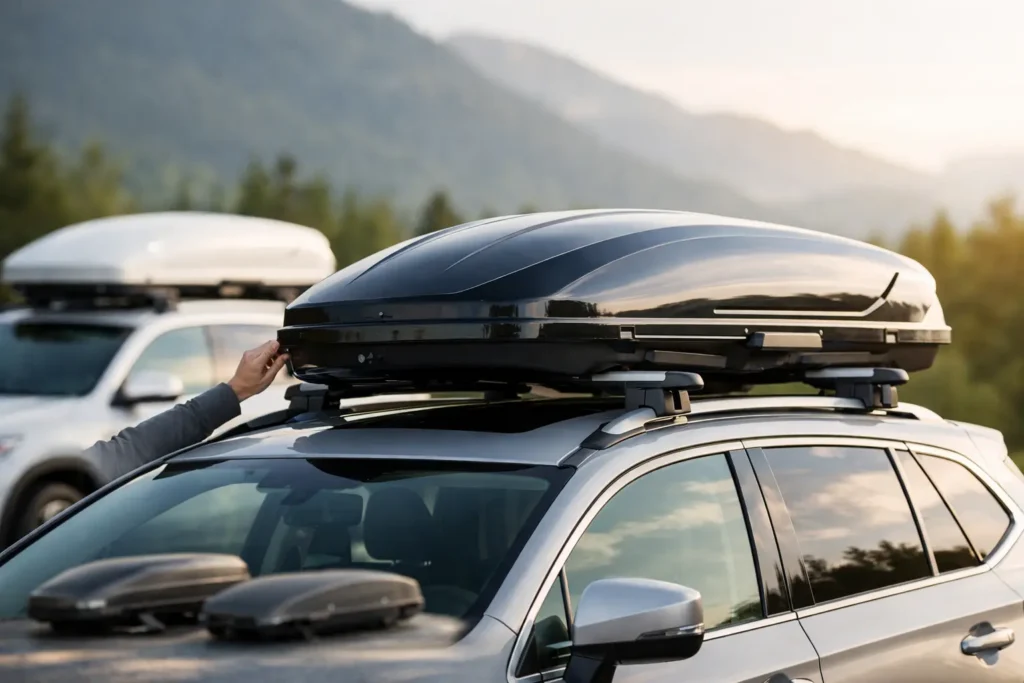
You need compatible roof bars first. Some cars have raised rails, some have flush rails, and some need a specific fitting kit. The roof box then has to match those bars and sit in the correct position on the roof. That position affects safety, weight distribution and whether you can still open the boot fully.
This is why choosing a roof box is rarely just about the box itself. It is about the full setup. A family hatchback, estate, SUV and saloon can all need slightly different solutions, even if the box capacity is similar.
If you are hiring rather than buying, professional fitting removes a lot of guesswork. That is particularly useful for first-time users who do not want to spend the evening before a trip trying to work out clamps, bar spacing and load limits on the driveway.
Roof load limits matter
Every car has a maximum roof load set by the manufacturer. That figure includes both the roof bars and the roof box, as well as the luggage inside it.
So if your car’s roof load limit is modest, simply choosing the largest box available may leave less usable carrying weight than you expected. This is one of those areas where practical advice beats assumptions. A slightly lighter or better-matched setup may be the smarter option.
Think about what you are carrying
When people ask how to choose roof box options, they often focus on litres alone. Capacity matters, but shape matters too.
Soft holdalls and coats are easy to load into most boxes. Prams, folding chairs and camping gear need a bit more thought because awkward shapes can eat into the available space. If you are carrying skis or very long items, that points you towards a different style of roof box than one designed mainly for general family luggage.
It is also worth remembering that roof boxes are best for lighter bulky items rather than your heaviest cases. Keeping the heaviest luggage lower down in the car usually makes more sense for handling and safety.
Ease of loading makes a difference
A roof box can look perfect on paper and still be frustrating in real life if it is awkward to use.
Wide openings, secure locking and straightforward fixing systems all make a difference when you are packing in a rush. Opening from the side that suits your driveway or parking position can also be more useful than many people expect. If you have ever tried loading a car while squeezed against a wall or on a narrow street, you will know why practical access matters.
Height matters as well. On a taller vehicle, loading a roof box is naturally more difficult than on a lower hatchback. That does not mean an SUV owner should avoid one, only that it is worth being realistic about how easy it will be to reach and arrange your luggage.
Buying versus hiring
For plenty of drivers, the better question is not just how to choose roof box products, but whether to buy one at all.
If you travel frequently throughout the year, buying may make sense. But for many families, roof boxes are used once or twice for summer holidays, maybe a camping weekend, and then they spend the rest of the year taking up space in the garage. That is before you factor in the cost of the box itself, roof bars, fitting kits and the time needed to install everything correctly.
Hiring can be the more sensible route if you want the benefit without the long-term commitment. You avoid the upfront purchase cost, you do not have to find somewhere to store a large box at home, and you can have the equipment fitted properly for your specific car.
That is a big part of why local motorists around Staffordshire and the West Midlands often choose hire for one-off trips. It keeps things simple and affordable, which is exactly what most people want before a holiday.
Safety should never be an afterthought
A roof box should feel secure at motorway speeds, not like a compromise you hope will be fine.
Good quality branded equipment matters because it is designed to lock properly, mount securely and cope with real use. Just as important is correct fitting. A badly fitted box can create noise, instability and risk. Even if it stays attached, poor positioning or loose fittings can make the journey more stressful than it needs to be.
You also need to pack it sensibly. Weight should be spread evenly, nothing should be loose inside, and the total load should stay within the car and box limits. After fitting, it is always wise to adjust your driving slightly – allow for extra height, take more care in strong winds and remember the car may feel a little different in corners.
Practical questions to ask before you decide
Before booking or buying, it helps to ask a few simple questions. Will the box fit my exact make and model? Do I need roof bars as well? How much luggage do I realistically need to carry? Will I use this more than once or twice a year? And do I want to fit it myself?
Those questions quickly narrow things down. They also stop you paying for more than you need.
For most customers, the best choice is not the most technical or the most expensive. It is the one that suits the car, suits the journey and takes pressure off packing day. That is why a straightforward hire service with fitting included is often the easiest answer. South Staffordshire Roof Box Hire, for example, focuses on exactly that – quality boxes, matching bars and proper fitting, without making customers wrestle with the setup themselves.
The best roof box choice is the one that gives you more room and fewer headaches. If it helps you set off with a clear boot, comfortable passengers and one less thing to worry about, you have chosen well.
